ID
Additively manufactured Smart nano-enabled thermoplastic Triply Periodic Minimal Surface cores for Energy-autonomous Sandwich composite panels – Smartwiches
- Project Number: 28695
- Scientific Area: Engineering Sciences & Technology
- Scientific Field: Chemical and Materials engineering
- Scientific Subfield: Materials engineering
- Total Budget: 99550.00 €
Inspired by nature
Biological materials such as trabecular bone, coral skeletons, nacre (seashell), plant vascular tissues and diatom silica structures exhibit hierarchical porosity and optimized stiffness-to-weight ratios (Figure 1).
These architectures have been widely reported in the biomimetics and cellular solids literature, demonstrating that natural systems achieve multifunctionality through geometric optimization rather than material complexity [Lee et al. Controlled Unusual Stiffness of Mechanical Metamaterials, 6:20312 10.1038/srep20312].
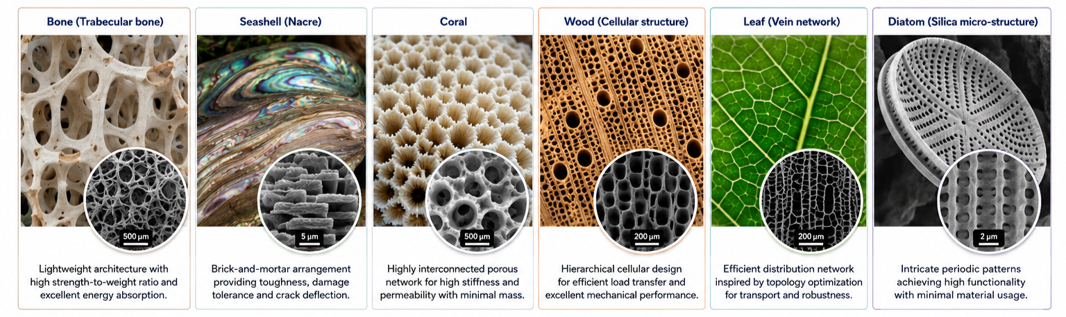
Figure 1. Nature-inspired cellular architectures.
Triply Periodic Minimal Surface TPMS geometries such as Gyroid, Schwarz Primitive (P), Diamond,
I-WP and Neovius surfaces are mathematically defined bicontinuous structures characterized by zero mean curvature and periodicity in three dimensions (Figure 2). These architectures have been extensively studied for their mechanical efficiency, transport properties, and energy absorption capability, particularly in the context of cellular metamaterials and biomedical scaffolds [Maskery et al. Insights into the mechanical properties of several triply periodic minimal surface lattice structures made by polymer additive manufacturing, Polymer 152 (2018) 62-71].
Additive Manufacturing enables the physical realization of these mathematically defined surfaces, allowing controlled tuning of porosity, anisotropy and multifunctional performance for advanced structural applications.
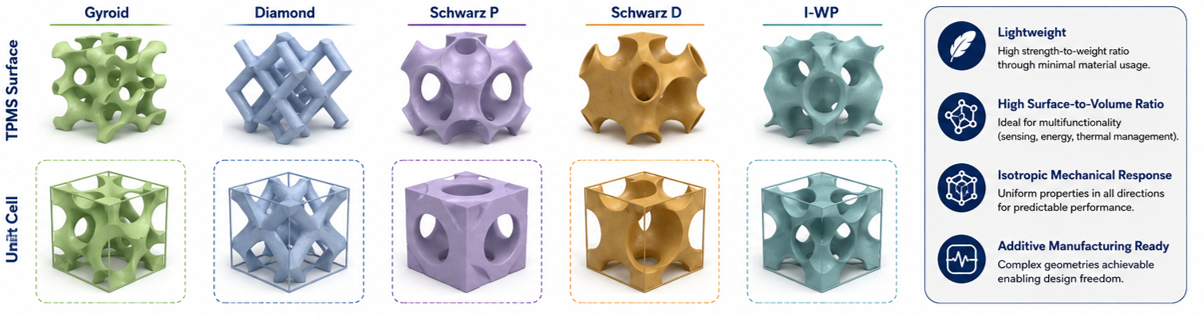
Figure 2. Triply Periodic Minimal Surface (TPMS) architectures for additively manufactured multifunctional materials.
Summary
Smartwiches is a multi-disciplinary 24-month project perfectly aligned with the HFRI’s funding policy of 4th Call for H.F.R.I. Research Projects to support Post-Doctoral Researchers aiming to deliver fully 3D printed composite sandwich panels with tailored mechanical performance, as energy harvesters, which will operate independently to send information for safety via activating commercial sensors in real-time at their operational environment. The energy autonomous concept relying on the vision of smart maintenance-free sustainable lightweight structures and constructions, since self-powered IoT (Internet of Things) modules will promote the secure operation of functional components without unforeseen structural aggravation, as for instance [1-6].
[1] Karalis et al. A carbon fiber thermoelectric generator integrated as a lamina within an 8-ply laminate epoxy composite: Efficient thermal energy harvesting by advanced structural materials. Applied Energy. 2019;253:113512.
https://doi.org/10.1016/j.apenergy.2019.113512.
[2] Karalis et al. Advanced Glass Fiber Polymer Composite Laminate Operating as a Thermoelectric Generator: A Structural Device for Micropower Generation and Potential Large-Scale Thermal Energy Harvesting. Applied Materials & Interfaces. 2021, 13 (20), 24138–24153.
https://doi.org/10.1021/acsami.1c04527.
[3] Karalis et al. Carbon fiber/epoxy composite laminates as through-thickness thermoelectric generators. Compos. Sci. Technol. 220 (2022) 109291.
https://doi.org/10.1016/j.compscitech.2022.109291.
[4] Karalis et al. Carbon nanotube fibers as efficient p- and n-type thermoelements within Geopolymers: A route for Large-scale Thermal energy harvesting from building structures. Cem. Concr. Compos. 153 (2024) 105699.
https://doi.org/10.1016/j.cemconcomp.2024.105699.
[5] Karalis et al. A high-performance thermoelectric generator device based on 3D printed TPU gyroid structures infiltrated with p- and n-type single-walled carbon nanotubes. Chemical Engineering Journal (2025) 166140.
https://doi.org/10.1016/j.cej.2025.166140.
[6] Karalis et al. Multifunctional carbon fibre reinforced polymer (CFRP) composites for sustainable and smart civil infrastructure: A comprehensive review. Sustainable Materials and Technologies (2025) e01594.
https://doi.org/10.1016/j.susmat.2025.e01594.
Visual

Acknowledgement for Funding
This research was supported by the Hellenic Foundation for Research and Innovation (H.F.R.I.) under the “4th Call for H.F.R.I. Research Projects to support Post-Doctoral Researchers” (Project Number: 28695).